Uniswap: The Official Uniswap App for Self-Custody Swaps
Uniswap powers more onchain trading volume than any other decentralized exchange, with billions in liquidity sitting across pools on Ethereum and a wide spread of EVM chains. The protocol lets traders swap tokens directly from a wallet they control, without ever sending funds to a custodian or signing up for an account.
The official Uniswap app at app.uniswap.org has served as the main entry point since the protocol's earliest days. Routing logic, gas optimization, and multi-chain support all flow through the same interface that connects to V2, V3, and V4 contracts.
Uniswap Labs maintains the front-end, but the underlying contracts answer to no central operator. Code is immutable, custody stays with users, and trades settle without intermediaries.
Jump to swap interface image anchor
Why Traders Use the Uniswap Exchange
The Uniswap exchange handles spot trading differently from any centralized venue, and that difference shows up in execution, costs, and what users actually own when they trade. Liquidity comes from anyone willing to deposit a pair of tokens, not from market makers paid by an exchange. Fees flow to those depositors instead of to a corporate treasury.
Permissionless Listings on Uniswap DEX
Uniswap DEX requires no approval, no listing fee, and no business development team to add a token to the platform. Anyone with an ERC-20 contract can deploy a pool and seed it with initial liquidity in a single afternoon. This permissionless property is why most new tokens debut on Uniswap before anywhere else, and why long-tail assets that would never qualify for a centralized listing still find tradeable depth here. The trade-off is that not every token deserves the access it gets, which puts the burden on traders to verify what they're buying. The interface flags unverified tokens, but the contracts themselves treat every pool the same way.
Uniswap Crypto Pricing and Slippage
Uniswap crypto pricing comes from constant-product math on V2 pools and concentrated-range math on V3 and V4, with the spread on any given trade depending on pool depth and trade size. Small swaps on deep ETH/USDC pools execute at near-mid prices with slippage measured in basis points. Large swaps move the price along the curve, and the bigger the trade relative to pool depth, the more it costs in execution. Aggregators sometimes split orders across multiple Uniswap pools and other DEXs to reduce that impact. The interface shows projected price impact before any swap signs, and traders can tighten the slippage tolerance if they prefer to revert rather than fill at a worse rate.
Trade Execution Speed on the Uniswap App
Trade execution on the Uniswap app runs at the speed of the underlying chain, which means seconds on Layer 2 networks and 12 to 15 seconds for Ethereum mainnet block times. Swaps confirm or fail atomically, so partial fills don't happen the way they sometimes do on centralized order books. UniswapX adds an off-chain order layer where swappers sign intents and fillers compete to execute at the best price, which can produce better outcomes than direct AMM trades on certain pairs. Gasless swaps work on supported chains for users who don't hold the native gas token. None of these features change custody, since funds always settle from and to user wallets directly.
Uniswap V2 as the Foundation Layer
Uniswap V2 sits underneath much of what the protocol does today, even though newer versions handle the bulk of volume. The contracts launched in May 2020 and have run untouched since, processing hundreds of billions in trades with no successful exploit at the protocol level. V2 remains the simplest version to understand and the most accessible for passive liquidity providers.
Constant Product Math in V2 Pools
Uniswap V2 pools follow the constant product formula where the product of token reserves stays equal across every swap, with a 0.30% fee added to the input side that effectively rebalances the pool slightly in favor of LPs over time. Math is intentionally simple because complexity at the contract level creates audit surface and gas costs. Every V2 pool covers the entire price range from zero to infinity, which means liquidity providers never have to think about ranges, ticks, or rebalancing. The downside is capital inefficiency, since most LP capital sits at prices that almost never trade. The upside is that nothing breaks when prices move dramatically, and LPs keep earning fees regardless of where the market goes.
LP Tokens and DeFi Composability
V2 LP tokens are fungible ERC-20 tokens representing a share of any given pool, which makes them composable with the rest of DeFi in ways V3 NFT positions can't fully match. Lending platforms accept V2 LP tokens as collateral, yield aggregators stake them in farming strategies, and treasury managers use them to express concentrated DeFi exposure without picking individual tokens. Sushi, PancakeSwap, and most other AMMs adopted the V2 model precisely because it works with everything. The combination of fungibility and predictable behavior across price ranges is why V2 still matters for tokens where simplicity beats efficiency. A new project launching a token rarely picks V3 for its first pool because the management overhead doesn't match what most early-stage tokens need.
V2 on Layer 2 Networks
Uniswap V2 deployment expanded across Layer 2 networks gradually, with Arbitrum, Optimism, Base, and several others now running official V2 contracts alongside V3 and V4. Cheaper gas on L2 makes V2 economics work better for smaller LPs, since the cost of providing liquidity used to be prohibitive on mainnet for anything under a few thousand dollars. Long-tail tokens often launch their initial pools on V2 across L2s because deployment is cheap and the math is forgiving. Volume on V2 L2 pools tends to be lower than V3 equivalents, but for new pairs the volume hasn't found V3 yet and V2 captures the early flow. Cross-chain comparison shows V2 still pulls meaningful daily volume across every chain it runs on.
Uniswap V3 Concentrated Liquidity Mechanics
Uniswap V3 turned the LP model into something closer to active market making, where capital sits in narrow price ranges and earns much higher fees per dollar deployed. The trade-off is that ranges need monitoring, and capital outside the active price band earns nothing. V3 currently settles the largest share of Uniswap volume across every major chain.

Concentrated Ranges and Tick Math
V3 splits the price curve into discrete ticks, each representing a 0.01% price increment, and LPs choose a range bounded by two ticks where their capital provides liquidity. Inside that range, the position behaves like a virtual V2 position but with much higher effective depth per dollar. Outside the range, the position sits entirely in one of the two pool tokens and earns no fees until price comes back. This design lets a stablecoin LP put $10K into a tight range around $1.00 and capture more fees than a $1M V2 position would on the same pair. Tick math handles the calculations efficiently inside the contract, which is why V3 swaps cost more gas than V2 but still less than most other concentrated-liquidity AMMs.
NFT Positions Versus Fungible Tokens
V3 positions exist as NFTs because each one has unique price boundaries that can't be averaged together the way V2 LP tokens can. The NFT contains all metadata about the position including the token pair, fee tier, range, and accumulated fees. Transferring a position means transferring the NFT, which is straightforward but doesn't compose with DeFi the way fungible tokens do. Vault protocols like Arrakis, Gamma, and Steer wrap V3 positions inside fungible tokens that automate range management for passive LPs, restoring composability at the cost of a small management fee. Without those vaults, V3 stays accessible mostly to LPs willing to manage positions actively or to LPs willing to set wide ranges and accept lower fee capture in exchange for less work.
V3 Performance Across Chains
V3 contracts run on every major Uniswap deployment, and performance varies based on liquidity depth and trader preferences on each chain. Ethereum mainnet hosts the deepest pools for ETH/USDC, ETH/USDT, and other blue-chip pairs, with billions in TVL spread across multiple fee tiers. Arbitrum and Base see similar pair concentration with lower TVL but proportionally higher capital efficiency because gas costs let smaller LPs participate. Polygon, Optimism, BNB Chain, and Avalanche each have their own V3 pool ecosystems shaped by which tokens are popular on those chains. The same V3 contract code runs everywhere, but the surrounding liquidity landscape differs enough that traders sometimes route the same swap through different chains depending on where depth sits.
| Chain | V3 TVL Range | Most Active Pair |
|---|---|---|
| Ethereum | High | ETH/USDC |
| Arbitrum | Mid-high | ETH/USDC |
| Base | Mid-high | ETH/USDC |
| Optimism | Mid | ETH/USDC |
| Polygon | Mid | MATIC/USDC |
Uniswap V4 and the Hook System
Uniswap V4 launched in early 2025 with the most ambitious changes to the protocol since V3. The architecture rebuilds how pools exist on chain and opens the protocol to permissionless customization that previous versions couldn't support. Adoption has grown steadily as developers explore what hooks make possible.
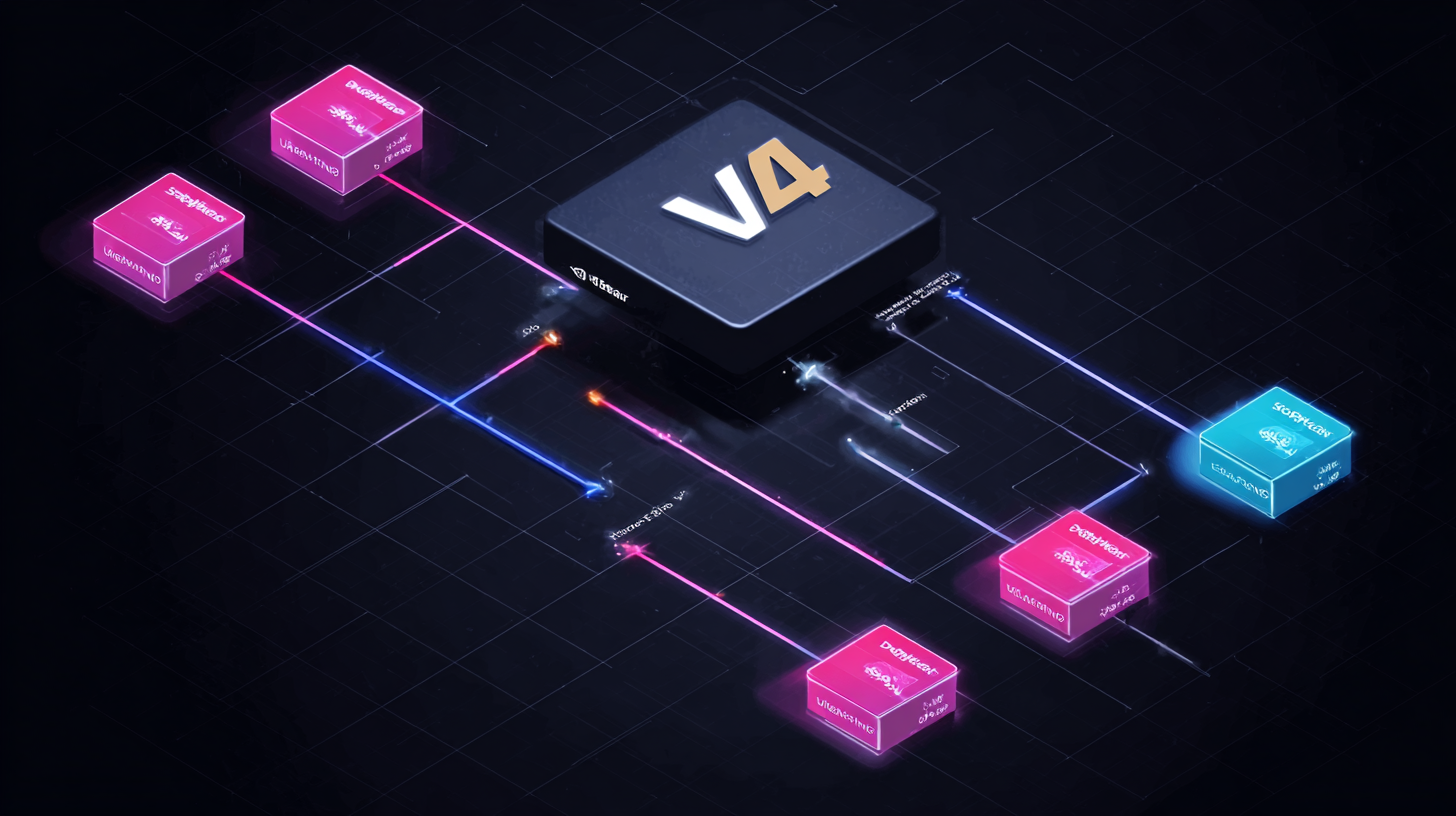
Singleton Contract Architecture
The V4 singleton holds every pool inside one contract address rather than deploying a new contract for each pool, which slashes deployment costs to almost nothing. Creating a new pool on V3 cost gas equivalent to a small token transfer, while V4 pool creation costs about 1% of that. Swaps got cheaper too because flash accounting nets balance changes across complex routes inside a single transaction without moving tokens at every step. Native ETH support returned, eliminating the WETH wrapping requirement that V2 and V3 forced on every ETH pair. These changes don't show up in the user interface, but they show up in gas costs and in what becomes economically viable for new pool deployments.
Hooks for Custom Pool Logic
Hooks are the headline V4 feature and represent the biggest expansion of what an AMM can do without forking the protocol. A hook is a contract that gets called at specific points in the pool lifecycle: before a swap, after a swap, before liquidity changes, after liquidity changes, and so on. Pool creators choose which hooks attach to their pool at deployment, and the hooks can implement nearly any logic the developer wants. Examples already shipping include dynamic fees that adjust based on volatility, on-chain limit orders that execute when price crosses a threshold, time-weighted average market makers that smooth out price impact, custom oracles that aggregate data differently than standard Uniswap oracles, and KYC-gated pools for institutional users. The hook ecosystem is still early, but the design space is large enough to keep developers building for years.
Adoption and Volume Trends on V4
V4 volume grew steadily through 2025 as more pools migrated and as new pools launched directly on V4 instead of V3. The migration isn't forced because V3 contracts keep running, but the gas savings and feature flexibility pull most new deployments toward V4 by default. Hook ecosystems specific to certain use cases have emerged, with stablecoin pools using volatility-aware hooks and meme tokens experimenting with anti-MEV hooks. Total V4 TVL still trails V3 because the older version had years of head start, but the trend points consistently toward V4 capturing a larger share over time. Traders interacting with the Uniswap app rarely notice which version handles their swap because routing happens automatically across all available pools.
Uniswap Pools as Liquidity Infrastructure
Uniswap pools function as liquidity infrastructure for much more than just the Uniswap interface itself. Aggregators, lending markets, derivatives platforms, and treasury management tools all read prices from or route trades through Uniswap pools. The pools have become base-layer plumbing for a large share of onchain financial activity.

Pool Discovery in the Uniswap App
Pool discovery inside the Uniswap app surfaces every active pool across every supported chain, with filters for fee tier, TVL, volume, and APR. Traders looking to provide liquidity scan this list to find pools matching their risk tolerance and return expectations. The interface shows historical fee accumulation, current price, and the distribution of existing liquidity ranges on V3 and V4 pools. New pools appear automatically as soon as anyone deploys them, including pools for tokens that just launched. Filtering by verified tokens narrows the list to assets that have been screened for obvious malicious behavior, which most LPs prefer over the unfiltered view.
Common pool selection criteria include:
- TVL above a minimum threshold for stability
- Daily volume sufficient to generate meaningful fees
- Fee tier matching the volatility of the pair
- Verified token status on both sides of the pool
- Active LP incentive programs from the protocol or third parties
- Reasonable distribution of existing liquidity ranges
Liquidity Concentration Patterns
Liquidity concentration patterns differ significantly between stablecoin pools, blue-chip pools, and long-tail pools. Stablecoin pools see most liquidity packed into ranges within 0.5% of $1.00, since prices barely move outside that band. Blue-chip pools like ETH/USDC show liquidity spread more widely but still concentrated within a few percent of current price. Long-tail pools often have liquidity scattered across wide ranges because LPs can't predict where price will settle and prefer broad coverage to active management. Reading these patterns helps LPs decide where to add capital, since adding liquidity in already-crowded ranges produces lower fees per dollar than finding underprovided ranges where competition is lower. The interface visualizes liquidity distribution on every pool page, making this analysis straightforward.
Yield Sources Beyond Trading Fees
Yield on Uniswap pools comes from trading fees first, but external sources add meaningful returns on certain pools. The Uniswap Foundation occasionally funds incentive programs that pay LPs in UNI or stablecoins for providing liquidity to specific pairs. Third-party protocols sometimes incentivize Uniswap pools for tokens they're trying to bootstrap, paying LPs in the project's native token. Optimism, Arbitrum, and other L2s have run liquidity mining programs that paid in their native tokens for LPs on Uniswap pools deployed to those chains. Stacking these incentives on top of trading fees produces total yields meaningfully higher than fees alone, though most incentive programs run for limited periods before ending.
Uniswap Token and Protocol Ownership
The Uniswap token UNI launched in September 2020 with a retroactive airdrop to anyone who had used the protocol. The token represents governance ownership of the protocol and a claim on whatever fee revenue UNI holders eventually decide to activate. Distribution covered roughly 60% of supply to community members, treasury, and grants, with the remainder going to the team and early investors on multi-year vesting.

Token Distribution and Holders
UNI distribution skewed heavily toward community from launch, with the airdrop alone covering 250,000 unique addresses that had interacted with the protocol before September 2020. Each eligible address received 400 UNI, which was worth a few thousand dollars at launch and rose dramatically during the 2021 bull market. Beyond the airdrop, ongoing community treasury allocations and grant distributions have spread additional UNI to contributors over the years. Investor and team allocations vested over four years and have now fully unlocked, which means circulating supply matches total supply plus future inflation from the perpetual emission schedule. Holder distribution today is broad, with both retail wallets and institutional treasuries holding meaningful positions.
Governance Activity Patterns
Governance activity on Uniswap has produced some of the most-watched proposals in DeFi, including debates over the fee switch, deployments to specific chains, and treasury management. Voter turnout depends heavily on the proposal, with high-stakes votes pulling out millions of UNI in delegated voting power and routine grants passing with much lower participation. Active delegates publish voting rationale before and after each vote, which provides accountability that pure on-chain voting alone wouldn't capture. Snapshot temperature checks filter out proposals that wouldn't pass before they ever reach on-chain votes, which saves gas and reduces governance fatigue. The system has flaws including low retail participation, but it has also successfully governed billions in treasury and shipped major protocol changes through coordinated voting.
UNI Market Liquidity
UNI market liquidity ranks among the deepest of any DeFi governance token, with active trading on Uniswap pools, Coinbase, Binance, Kraken, OKX, and most other major exchanges. Onchain liquidity sits primarily in ETH/UNI pools across V2, V3, and V4 deployments, with stablecoin/UNI pools providing additional depth for traders who don't want ETH exposure. The token's role as collateral on Aave and Compound adds another liquidity dimension, since borrowers can leverage UNI positions without selling. This combination of governance, market, and lending utility gives UNI more functional weight than tokens that exist primarily as voting shares.